
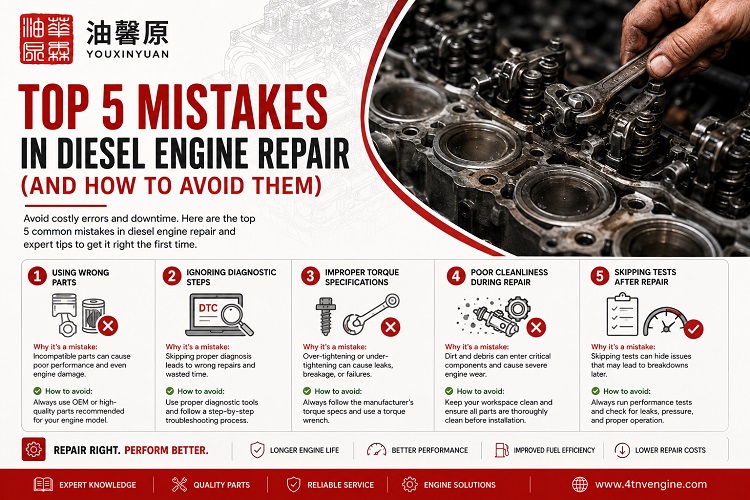
Top 5 Mistakes in Diesel Engine Repair (And How to Avoid Them)
A diesel engine runs on precision – exact fuel pressure, exact tolerances, and exact timing. When a repair goes wrong, it rarely fails quietly. It’s not a repeat breakdown, a broken turbocharger or a dirty fuel system. Most of the time these are failures not attributable to the initial problem; they’re attributable to how the problem was handled. Common problems arise repeatedly in the workshops and fleet yards, resulting in around a $500 repair and a $5000 rebuild. Let’s take a look at the top five most harmful ones.
Mistake 1: Fixing the Symptom, Not the Root Cause
This is the most expensive repair error for a diesel engine. A technician clears a clogged DPF – 3 months later it clogs up again. A new turbocharger is fitted – fails in weeks. It was not the part that was the issue. It’s a result of something upstream.
Diesel systems are tightly coupled. Excessive soot is produced by a misfiring injector, which causes the DPF to become clogged. Oil starvation destroys the turbo, but the real cause was a blocked oil feed line that was never inspected. Before ordering any parts always run a full diagnostic scan. A fault code is not the end but a beginning.
Mistake 2: Using the Wrong Oil or Substandard Parts
If the repair is performed using an incorrect oil or low-quality parts, it is not a repair; it’s a delayed failure. The compression ratio and operating temperature of a diesel engine are higher than those of a gasoline engine. Using conventional motor oil made from gasoline causes accelerated engine wear and increased ash build-up in the DPF and causes the ash to build up at a rate that is too high for the DPF.
It also applies to parts. Aftermarket injectors cost much less but are not likely to maintain proper calibration when operating. The non-OEM head gasket may seal up at start-up but then fail in several months due to thermal cycling. Always use OEM or verified quality parts, and be sure that the oil conforms to the manufacturer’s diesel specification (particularly for DPF engines).
Mistake 3: Ignoring the Cooling System During Repairs
Cooling systems take a beating when they are not repaired, and they are far more efficient than gasoline engines. Technicians who are involved in fuel or injector work often neglect to check or maintain coolant condition and thermostat health, and the resulting problems continue to cause damage after the repair.
In a diesel engine, overheating is always serious. Warps cylinder heads, weakens head gaskets, and, in extreme cases, can cause complete block failure. The cooling system should be checked during any time of significant maintenance of a diesel engine, not waiting for another day.
Mistake 4: Incorrect Torque on Critical Fasteners
Every aspect of diesel engine repairs requires precision. Head bolts, injector hold-downs, main bearing caps and manifold fasteners have precise torque requirements. Undertightening results in leaks and component motion under load. Overtightening causes threads to become loose, distorts sealing faces, and causes stress fractures, which only manifest themselves when the engine is under full operating pressure.
This is a common error when rushing to finish a job or when a technician is replacing another one in the middle of repair work.
Mistake 5: Doing Advanced Repairs Without Diesel-Specific Expertise
Modern diesel engines are complicated. Specialist knowledge and tooling are required for high-pressure common rail systems, variable geometry turbochargers, ECU-controlled injection timing and emissions aftertreatment. A generic mechanic, who does not have diesel training, will not be able to diagnose the fault codes properly and will be unable to handle the high-pressure elements and can leave the engine in a worse state than before.
When non-specialist workshops try to fix a diesel engine, almost 40% of problems are wrongly diagnosed.
Conclusion
Every mistake in this blog shares one thing – it was avoidable. Properly repaired diesel engines prevent further breakdowns, unnecessary downtime and escalating bills when they come back.
If there’s the same repair work over and over, it’s time to work with a team that can discover the actual problem. At 4TNV Engine, our focus is on providing precision repairs and complete rebuilds for diesel engines in fleet vehicles and equipment, ensuring that it is done right, once.
Call 4TNV Engine today and have your diesel restored to its original power and performance.
FAQs
How do I know if my diesel engine repair was done correctly?
A complete repair will have a post-job diagnostic scan, no fault codes displayed, and no recurrence of the original symptom under normal operating conditions.
Can wrong engine oil really damage a diesel engine?
Yes – non-diesel oil breaks down more rapidly when compressed in hot conditions, causes internal wear and promotes ash deposition in emission assembly parts such as the DPF.
Are aftermarket parts safe for diesel engine repair?
Only if they meet OEM specifications from a verified supplier. Unrated parts, which are general in nature, are much more likely to fail.