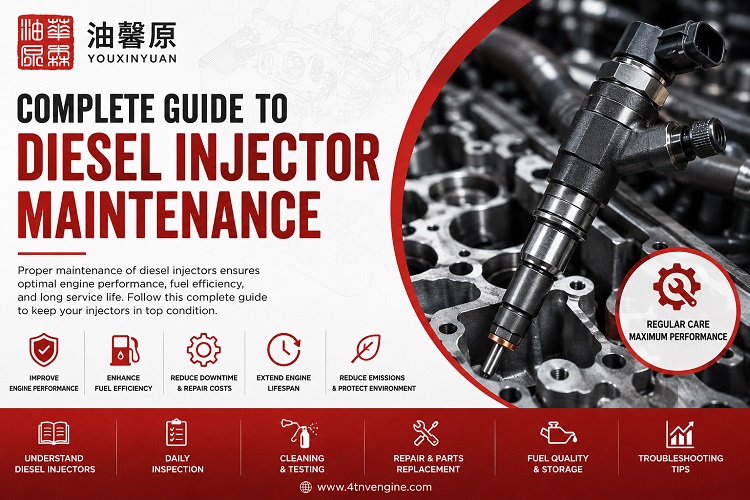
Complete Guide to Diesel Injector Maintenance
Your diesel engine can push hundreds of thousands of miles – but only if the one component responsible for precise fuel delivery is properly maintained. The diesel injector is not just a fuel tap. It can operate under pressures of over 30,000 PSI, deliver fuel in doses of cubic millimeters, and be fired thousands of times per minute. When it begins to malfunction, without making a noise or any visible sign, the whole engine suffers before you have even noticed that something has gone wrong.
This guide provides you with what diesel injector maintenance really involves, what warning signs to keep an eye on, and what it takes to ensure your fuel system lasts the long haul.
Why the Diesel Injector Demands Consistent Attention
All of your diesel injectors are high-quality instruments – not a commodity part. It regulates the time of combustion, the atomization of fuel, and the resulting amount of emissions simultaneously. When either of the injectors performs poorly, it introduces cylinder imbalances that propagate in power output, fuel consumption and exhaust quality.
Maintenance is so important because of the tolerance. The in-house clearances within a contemporary injector are expressed in terms of microns. Even microscopic contamination such as particles in the 1-5 micron range can result in rapid erosive wear that may dramatically reduce the life of components. The fact is that the majority of diesel injector failures are not associated with manufacturing errors. They are attributed to poor or uneven maintenance.
The Most Common Causes of Diesel Injector Failure
Knowing the failure modes will help you avoid it. The following is what harms the diesel injectors the most often:
- Fuel Contamination: Contaminated fuel is the number one cause of injector failure industry-wide, as it is the cause of over 60 percent of incidents. All the dirt, debris, and microbial growth in storage tanks find their way into the fuel system.
- Water Ingress: Water pits precision-machined internal surfaces, causes pitting on the needle and seat, and in high-pressure systems can flash into steam at the tip of the nozzle – causing immediate, catastrophic damage.
- Accumulation of Carbon Deposits: Carbon deposits bake onto the injector body and nozzle over time, disrupting spray patterns and accuracy of fuel metering. This causes engine knocking, misfires and unfinished combustion.
- Low Fuel Lubricity: New Ultra-Low Sulfur Diesel (ULSD) has lower natural lubricity properties than older diesel formulas. In the absence of appropriate additives, the wear of injectors develops at an unexpected pace.
- Solenoid and Electronic Failure: Damaged wiring, short circuits, or water in the ECU system can compromise the solenoid that controls injection timing – leading to rough running and excessive fuel consumption.
Warning Signs You Should Never Ignore
A malfunctioning diesel injector will not make a lot of noise initially. Keep an eye on these indicators before they get costly:
- Noticeable drop in fuel economy without any change in load or driving patterns
- Rough idle, engine vibration or unstable RPM at start.
- Difficult to start, particularly during cold weather.
- Darker or more black exhaust smoke when accelerating.
- Weakness during load or slow throttle response.
- Misfires of the engine or sudden bursts during the drive.
When two or more of these exist at the same time, your common rail fuel system should be diagnosed professionally before the problem worsens.
Best Practices for Core Diesel Injector Maintenance
Complex procedures are not necessary in maintaining a good injector. It involves regular practices that are incorporated in your routine service program.
- Always Use High-Quality Fuel: The type of fuel you use directly influences the duration of life of your diesel injector. Never empty reputable stations to mitigate the risk of contamination, since low-grade fuel has higher levels of particulates and water.
- Replace Fuel Filters on Schedule: The first line of defense of your common rail fuel system is fuel filters. Change them at the manufacturer-recommended regularity with the proper micron rating – a worn filter is commonly the step just before injector damage.
- Add a Quality Fuel Additive: An effective diesel additive balances the decreased lubricity of ULSD and prevents the accumulation of deposits throughout the fuel circuit. The maintenance doses of a regular maintenance are more effective than reactive high-concentration cleaners.
- Run Periodic Deep-Clean Treatments: Professional injector cleaning -in-vehicle flush or ultrasonic bench cleaning – should be scheduled after every 50,000 to 80,000 km. Ultrasonic cleaning will restore the spray patterns that cannot be restored by in-tank additive.
- Conduct Visual and Diagnostic Checks: Periodically check the injector body, seals, and O-rings to ensure that there is no leakage. Add to this electronic diagnostics to detect solenoid anomalies or fuel feed deviations early.
When the Diesel Injector requires replacement
Not all diesel injectors can be brought back. If flow testing shows a unit is more than 5% out of specification compared to the others, or if physical damage to the nozzle or control valve is confirmed, replacement is the right call.
When changing injectors, make sure to exactly match the part number to the original specification. It is possible to replace one of the injectors individually, but replacing all the units simultaneously is a sure way of maintaining a consistent combustion balance across all the cylinders, which is particularly important when dealing with a high-performance or common rail fuel system.
Conclusion
Maintenance of diesel injectors is not a reactive process – it is a continuous process of operation. From fuel quality and filter intervals to additive use and periodic diagnostics, every habit compounds into either longer component life or earlier failure. The expense of regular maintenance is just a fraction of the cost of a single injector replacement – much less a complete set.
Assuming your business relies on diesel equipment that is running reliably, you require a supplier that comprehends precision just as much as your injectors do. XiaMenJin HuaSen provides OEM-quality diesel injector parts, complete injectors, and spare parts that are compatible with the most popular brands such as Bosch, Denso, Delphi, and Cummins – engineered to be accurate, tested to be durable, and supported by real technical support.
FAQs
How often should a diesel injector be cleaned?
To maintain it, add fuel additives at every 3,000 to 5,000 km. It is suggested that a professional deep-clean service be done every 50,000 to 80,000 km depending on the operating load.
Can dirty injectors damage the engine long-term?
Yes. Poor combustion is caused by dirty injectors and over time, it damages pistons, cylinder walls and emissions components, and this will greatly increase the cost of repair.
What is the difference between in-tank cleaner and ultrasonic cleaning?
In-tank cleaners are effective in light deposits and on a regular basis. Ultrasonic cleaning eliminates extreme build-up of carbon and completely recovers spray patterns – something pour-in additives cannot do.
How do I know if my diesel injector is leaking?
Symptoms include sweet fuel odor, elevated oil content as a result of fuel dilution, black smoke, and harsh idle. A pressure test and visual inspection will confirm a leaking injector.