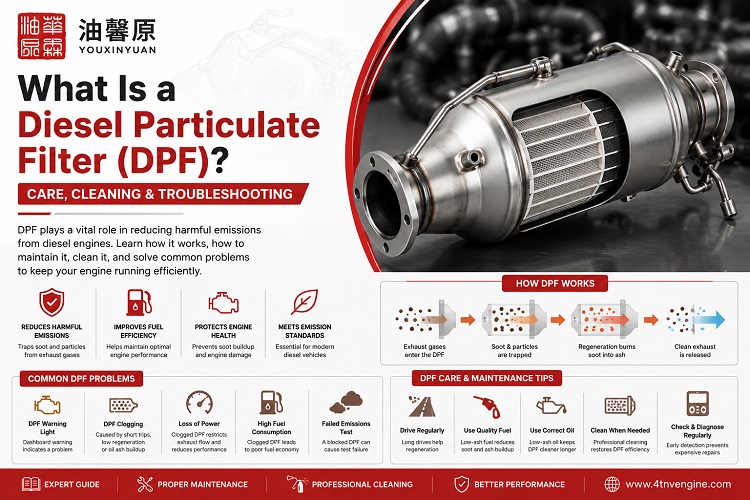
What Is a Diesel Particulate Filter (DPF)? Care, Cleaning & Troubleshooting
Most diesel engine operators are familiar with a DPF, but few understand the extent of the damage that can occur if it’s neglected. It’s not just a grungy emission device in the exhaust line. A damaged or dirty DPF causes exhaust back pressure, meaning the turbocharger gets less air, increases fuel usage, and in extreme cases will cause limp mode that will physically limit the power the engine can provide to protect itself from further damage. The cost of replacing a DPF varies from $3,000 to $10,000 per application.
However, the majority of these failures are avoidable if the appropriate knowledge and maintenance practices are used. Here’s what every fleet manager, equipment operator, and diesel vehicle owner needs to know.
What Does a DPF Actually Do?
A diesel particulate filter (DPF) is a type of exhaust aftertreatment system fitted in the exhaust system of modern diesel engines. It is designed to filter the soot and particulate pollution that is created when diesel is burned before it is emitted into the air. Fine particles are trapped inside the filter structure as the exhaust gas moves through the porous walls of the ceramic filter.
The DPF has a limited capacity and can’t store soot forever. It uses a process called regeneration to burn off soot and clean up regularly.
There are two major types:
- Passive Regeneration: Performs on its own during continued highway operation at high exhaust temperature when the soot is burned off by itself.
- Active Regeneration: Starts when passive regeneration has not been performed by the engine management system. The ECU increases the amount of fuel added to the exhaust to help it burn off and increase temperatures. This is usually repeated every 300 miles or so, and it takes 5-10 minutes.
If the above two approaches are inadequate, the ash and soot may build up and require professional cleaning or replacement.
The Most Common DPF Problems in Diesel Engines
The best way to avoid DPF failure is to understand what causes it. It’s not the fault of the filter itself; it is the fault of the engine operation and maintenance.
1. Short-Trip and Stop-and-Go Operation
This is the most common reason for early DPF plugging. Passive regeneration can never get high enough exhaust temperature to occur when the vehicles or equipment are operated primarily in urban environments, at low speeds, or on frequent, short runs. The filter can’t self-clean fast enough to catch all the soot, and, over time, the filter will become completely clogged. School buses, municipal trucks, and city delivery fleets are particularly vulnerable to this pattern.
2. Ash Buildup from Engine Oil
Ash is not combustible (can’t be burned off during regeneration), whereas soot is. Ash is deposited as a result of engine oil combustion and remains within the walls of the DPF. Eventually it limits airflow, creates back pressure and reduces the lifespan of the filter, no matter the quality of the regeneration control. Using the correct low-ash, diesel-rated engine oil is not optional on DPF-equipped engines – it’s a fundamental requirement.
3. Faulty Sensors and Incomplete Regeneration
DPF systems rely on sensors, namely differential pressure sensors, temperature sensors, and oxygen sensors, to determine the level of filter load and to initiate the regeneration process when needed. If a sensor is faulty or gives inaccurate readings, the engine management system might not begin regeneration when it should or begin regeneration at the wrong time. This creates an ongoing buildup of soot that is not cleaned until the filter becomes completely clogged, sometimes manifesting as the DPF warning light on the driver’s console.
4. Low-Quality or High-Sulfur Fuel
Fuel quality has a direct effect on the amount of soot generated each combustion cycle. The lower quality fuel with high sulfur content and poor lubricity burns less cleanly, producing more particulates per cycle and loading the DPF much quicker than designed. One of the easiest and most effective methods to prolong the length of DPF service is to use ultra-low sulfur diesel (ULSD) from reputable suppliers.
5. Poor Engine Condition Upstream
A DPF problem is more likely to be a sign of a bigger problem in the engine than a standalone problem. Dirty or worn fuel injectors that don’t spray fuel evenly or spray at the wrong time, or bore polishing on the pistons, can all lead to excessive soot formation during combustion. The DPF captures this excess soot and clogs prematurely. If you clean the DPF without resolving the upstream cause, then you will be stuck with the failure again within a short period of time.
How to keep your DPF in good condition?
The key to preventing DPF failure is to maintain the filter properly. The following practices have the greatest impact:
Let the regular regeneration cycles to complete. Do not turn the engine off during a cycle when the DPF warning light is on. Do not close if there is active regeneration of the resource.
Always use manufacturer-recommended low-ash engine oil. Standard oils cause ash to build up in the filter.
Always use good quality, low-sulfur fuel. Fuel quality for each fill affects every combustion cycle, and it has a direct effect on the production of soot.
Maintain fuel injectors, air filters, and fuel filter conditions. A healthy diesel engine creates less soot, meaning the DPF fills up slower and can be cleaned more often.
Schedule professional DPF cleaning at suitable intervals. A cleaning service is beneficial for most operators every 6 months, depending on the application and operating conditions.
Avoid excessive idling. Exhaust gas temperature is not high enough at idle to enable regeneration, so soot can build up without being removed.
Conclusion
A DPF is not a “one size fits all” filter. It is one of the most maintenance-sensitive parts of any modern diesel engine – and one of the most expensive to replace when neglected. Fortunately, most DPF failures are completely preventable, provided you follow the right operating practices, choose the right oil and fuel, and follow the correct maintenance schedule.
Don’t wait until your diesel engine fails before checking for DPF warning lights, reduced power or rising fuel consumption. At 4TNV Engine, we provide expert diesel engine diagnostics, DPF servicing, and full engine maintenance support for both fleet operators and individual equipment owners. We know the entire system, not just the filter. Call 4TNV Engine today and take a proactive approach to the issue rather than a reactive one.
FAQs
How long should a DPF last on a diesel engine?
The normal lifespan of a DPF filter is 100,000 to 150,000 miles. Service life may be reduced in vehicles operating in the “stop and go” condition or for short trips.
Can I drive with a DPF warning light on?
Yes, short-term, but if ignored, it will just completely block you out, and then you’ll need to go into “limp mode” and have a much more costly repair. Address it as soon as possible.
What if a DPF becomes “clogged”?
It will switch to restricted performance mode, fuel usage will increase, and will not be able to run for long without causing damage to the turbocharger.