Troubleshooting Marine Diesel Engines: Key Tips
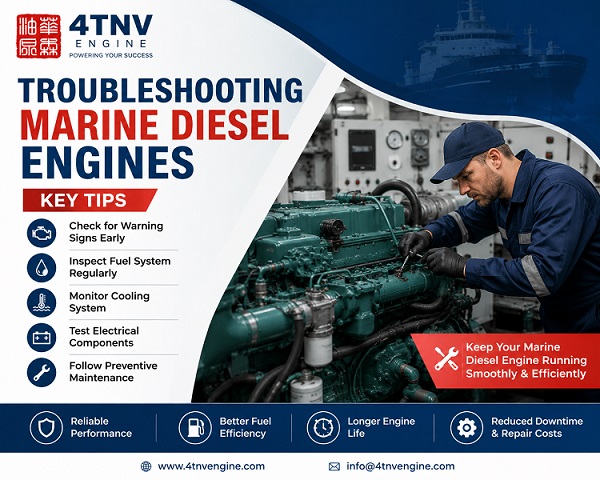
Most marine diesel engine failures do not occur on a sudden basis but rather develop over time through progressive warning indicators that are ignored. Any of these is an indicator to be taken seriously: a sluggish starter, a climbing temperature gauge, black smoke from the exhaust, or an unusual shaking noise. These are the first signs you should look for for fleet operators and marine professionals to help avoid a costly emergency at sea or a quick fix at dockside. Here are five of the more prevalent issues with diesel engines in marine use, and what the most obvious cause is, as well as a direct fix.
5 Common Marine Diesel Engine Problems & How to Solve Them
Marine diesel engines are sensitive to constant stress: saltwater, loads, and restricted repair times. Identifying the problem areas and knowing what to look for saves time and money.
1. Engine Hard Starting
One of the most frequent complaints made about marine diesel engines is starting failures, and they’re invariably the result of a failure in the electrical or fuel system.
Problem: Weak or dead battery, corroded terminals, or an accidentally engaged kill switch. Fuel-related issues can also be a problem, such as a shut-off valve, water in the fuel, or a clogged filter that can make the engine fail to start.
Solution: Check battery voltage and clean battery terminals. Verify the position of the kill switch and any active ECU fault codes. Open the fuel valve completely and check the fuel for contamination, replacing the filter if it appears to be in any way contaminated.
2. Black Smoke from Exhaust
Exhaust smoke that is black indicates that combustion is not occurring properly in the engine and will lead to further deterioration if the engine continues to operate without remediation.
Problem: Blocked air filter, poor turbocharger performance, or worn injectors that are pushing fuel through the system without combustion.
Solution: Check and change the air filter. Inspect turbocharger boost pressure; inspect for intake leaks. Have injectors tested and replace all poor or inconsistent fuel atomization.
3. Marine Engine Overheating
Overheating is one of the quickest ways that can permanently damage diesel engines at sea. Running hot, even for a brief duration, can cause cylinder heads to warp and cause damage to the internal parts.
Problem: Raw water intake is blown open, disrupting the flow of seawater to the cooling circuit. During operation, a broken impeller, a clogged heat exchanger, or a failing thermostat can all stop heat from being properly dissipated.
Solution: Check that the sea seacock is fully open and clear the intake strainer. Check the raw water impeller and change it right away if the blades are cracked or broken. Clean the heat exchanger, check the thermostat, and refill the coolant if needed.
4. Excessive Fuel Consumption
If fuel consumption has increased and the operating conditions have stayed the same, the engine is trying to work harder than it needs to, and so are your costs.
Problem: Dirty injectors delivering poor fuel atomization, a restricted air intake forcing higher fuel demand, or running the vessel outside the manufacturer’s recommended RPM range consistently.
Solution: Replace or service injectors and check for proper spray delivery. Replace or clean the air filter, and ensure that the air intake system is clear of obstructions. Check the operating RPM vs. engine load curve – operating within the optimum range will result in fuel savings over time.
5. Unusual Engine Noise or Vibration
Mechanical issues can cause the engine to make abnormal noises or vibrations, and if it does, it’s not a problem that can be ignored for a while; it is one that will only get worse.
Problem: If the bearings are worn out, if the timing is off, or if the oil pressure is low. Vibration is commonly caused by a misaligned propeller shaft, deteriorated engine mounts, or a damaged propeller.
Solution: Check oil level and pressure immediately; if low, shut off. Inspect engine mounts and replace if worn. If the vibration persists, have the propeller shaft alignment and propeller balance checked by a professional.
Conclusion
For each symptom that a marine diesel will exhibit, there is a definite cause and a definite solution. The key to keeping commercial vessels productive and crews safe is to be able to respond early before little problems grow into major failures. Preventive sea maintenance is always less costly than emergency sea maintenance. XiaMenJin HuaSen provides high-performance diesel engines and marine parts designed to meet demanding commercial marine requirements. Whether it’s replacement parts or full engines, they provide the reliability that serious operators rely on. Avoid minor problems from turning into an at-sea disaster.
FAQs
What causes black smoke from a marine diesel engine?
It indicates incomplete combustion, which typically occurs due to a clogged air filter, a weak turbocharger, or worn-out injectors.
What can I do to prevent my marine engine from overheating?
Most causes of overheating are due to cleaning the raw water intake, checking the impeller, and flushing the heat exchanger.
Why is my marine diesel consuming more fuel suddenly?
The most common causes are dirty injectors, a clogged air filter, or operating the engine outside its recommended RPM range.