How a Diesel Engine Works: Step By Step Guide
Many beginners wonder how a diesel engine works. In simple terms, a diesel engine utilizes the compression and ignition of diesel fuel to do useful work. The air is compressed until it’s really hot, then diesel is sprayed into the chamber, which spontaneously ignites, producing power.
Because they are powerful and more cost-effective than alternatives, diesel engines are found in vehicles like trucks and ships. Diesel engines don’t use spark plugs like gasoline engines, but rely on compression ignition, which makes them more durable and fuel-efficient.
What Is a Diesel Engine?
A diesel engine is a machine that powers vehicles or machines using diesel fuel. It functions by compressing air within a cylinder until the temperature becomes high enough for diesel fuel to ignite. The fuel ignites by itself due to the hot air, creating energy.
Because of this, diesel engines are more powerful than conventional engines and are fuel-efficient too. This is why they might be found in trucks, buses, and large machinery which has to operate for long periods.
Main Components Involved in Diesel Engine Operation
To understand how a diesel engine works, it’s essential to know the key components that make it function smoothly:
Cylinder
Fuel combustion and air compression typically take place in the cylinder. Its accurate design enables optimal pressure and heat build-up.
Piston
The piston has an up-and-down motion in the cylinder. As the air is compressed, its temperature increases, and during combustion, the expanding gas pressure is converted into motion.
Fuel Injector
The diesel fuel is sprayed under pressure by the fuel injector into the hot compressed air. Timing is accurate to provide efficient combustion and optimum power.
Crankshaft
The crankshaft transforms the linear movement of the piston into rotational movement that eventually drives the vehicle or equipment.
Intake and Exhaust Valves
These valves regulate the air entering the cylinder and leaving the cylinder so that fresh air enters the engine and exhaust gases leave the engine with each engine stroke.
How a Diesel Engine Works: Step-by-Step Process
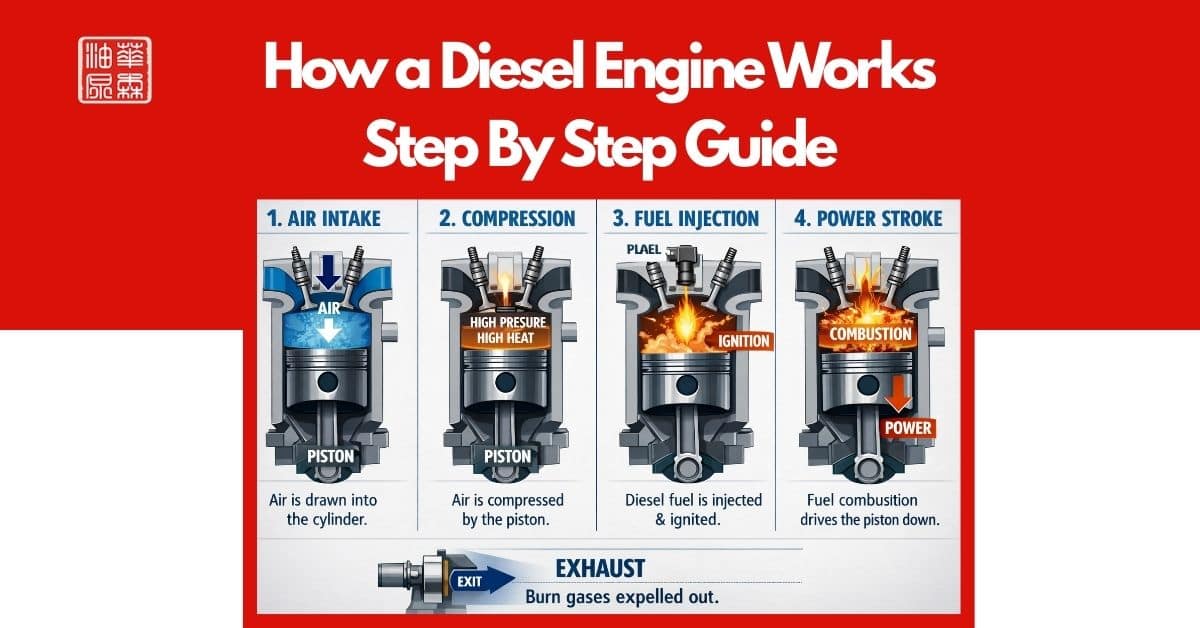
The working of a diesel engine revolves around a four-stroke cycle. Here’s a step-by-step explanation:
Step 1: Air Intake Stroke
The intake valve allows fresh, clean air to enter the cylinder. At this point, the engine simply receives air, and no fuel is introduced. The fuel will subsequently be burnt with the help of this air.
Step 2: Compression Stroke
The piston moves upward and compresses the air very tightly. This compression causes the air to be very hot which is significant since diesel fuel will burn due to this heat without a spark.
Step 3: Fuel Injection
Diesel fuel is sprayed on the hot compressed air. The fuel is sent into small droplets and combines favorably with the air. Due to the hot nature of air, the fuel will automatically catch fire. No spark plug is needed.
Step 4: Combustion and Power Stroke
As the fuel burns, it creates a powerful combustion that propels the piston downward. This force produces mechanical energy that drives the engine. This is the primary phase at which the engine generates power.
Step 5: Exhaust Stroke
Once the fuel is burned, the piston is pushed back upward, pushing the exhaust gases out through the exhaust valve. The cylinder has now been emptied and is prepared to begin the process once more.
Why Diesel Engines Work Without Spark Plugs
Diesel engines are dependent on compression ignition, which is the formation of high-temperature air, which is then compressed, and the injected fuel automatically ignites. This sparkless process enables diesel engines to have greater torque and superior efficiency compared to petrol engines, which need spark plugs to initiate the combustion process.
Diesel Engine Working Cycle Explained Simply
The diesel engine operates on a four-stroke cycle:
Intake Stroke: The intake valve brings new air to the engine that fills the cylinder. Later this air is required to burn the fuel.
Compression Stroke: This is the stroke in which the piston pushes the air upward and compresses it. This causes the air to be very hot and this is essential for burning the diesel fuel.
Power Stroke: Diesel is sprayed into the hot compressed air. It automatically lights up and the explosion propels the piston down and this forms the engine power.
Exhaust Stroke: Once the fuel is burned the piston forces the remaining gases out through the exhaust valve clearing the cylinder until the next cycle.
These strokes repeat continuously, powering vehicles or machinery efficiently.
Diesel Engine vs Petrol Engine: Working Principle Comparison
| Feature | Diesel Engine | Petrol Engine |
| Ignition Method | Compression ignition | Spark ignition |
| Air–Fuel Mixing | Inside cylinder | Before combustion |
| Compression Ratio | High | Lower |
| Efficiency | Higher | Lower |
Diesel engines are more suitable for heavy loads and long-term use due to their efficiency and durability.
Why the Diesel Engine Working Principle Is More Efficient
The diesel engine’s efficiency comes from:
- Diesel engines compress air more than petrol engines thereby making it very hot and allowing the fuel to combust fully to generate lots of energy.
- They are more efficient in the use of heat, and therefore less energy is wasted, while more fuel is converted into power.
- Each liter of diesel fuel contains more energy that the engine can utilize efficiently.
- This efficiency has made diesel engines require less fuel to perform the same amount of work hence they are suitable for long distances and heavy loads.
Where Diesel Engines Are Commonly Used
The common use of diesel engines is in situations where there is a need for power, efficiency, and durability. They operate heavy-duty vehicles such as trucks, buses, and SUVs and are also utilized in the diesel generator to create electricity.
They can be found in ships, trains, and construction and farm machinery. These demanding applications require reliable and durable engines since they are dependable on their basic, but effective working principle.
Conclusion
How a diesel engine works is essential knowledge for anyone interested in vehicles, machinery, or engines. By relying on compression ignition, diesel engines deliver higher efficiency, durability, and torque than petrol engines. Whether it’s trucks, generators, or ships, the diesel engine remains a reliable choice for heavy-duty applications.
FAQs
How does a diesel engine work step by step?
A diesel engine draws in air, compresses it until it’s very hot, injects fuel, ignites it automatically, and expels exhaust gases.
How does a diesel engine ignite fuel without a spark?
Diesel fuel ignites due to the high temperature of compressed air in the cylinder, eliminating the need for spark plugs.
What is the basic working principle of a diesel engine?
Compression ignition is the core principle: fuel ignites due to heat generated by compressed air.
Why is a diesel engine more efficient?
Higher compression, better thermal efficiency, and energy-dense diesel fuel lead to better fuel utilization.
Do diesel engines last longer?
Yes, they are built stronger, operate at lower RPMs, and are designed for long-term heavy-duty use.