Choosing the Right Diesel Engine Oil: Types, Specs & Change Intervals
Introduction
You can buy the best diesel engine on the market, run it on the right fuel, and maintain every component with precision — and still damage it slowly by choosing the wrong oil. It is not dramatic. It is simply chemistry working against you, one heat cycle at a time. If you operate diesel-powered equipment — whether that is a fleet of commercial trucks, agricultural machinery, or industrial generators — what goes into the crankcase matters more than most operators realize. This guide cuts through the label noise and gives you exactly what you need to make the right call.
Why Diesel Engine Oil Is Not the Same as Regular Motor Oil
Before anything else, this distinction needs to be clear. Diesel engines generate more combustion by-products — including acidic blow-by gases and soot — than gasoline engines. Gasoline engine oil is not designed to handle that level of contamination. Diesel engine oil contains higher concentrations of detergents, dispersants, and alkaline additives to neutralize acids and keep soot in suspension until the next oil change. Using the wrong type of oil does not simply reduce performance — it accelerates wear on rings, bearings, and cylinder walls in ways that may not become apparent until serious damage has already occurred.
The Three Main Types of Diesel Engine Oil
Knowing what your options are is the first step. There are three main types:
Conventional (Mineral) Oil
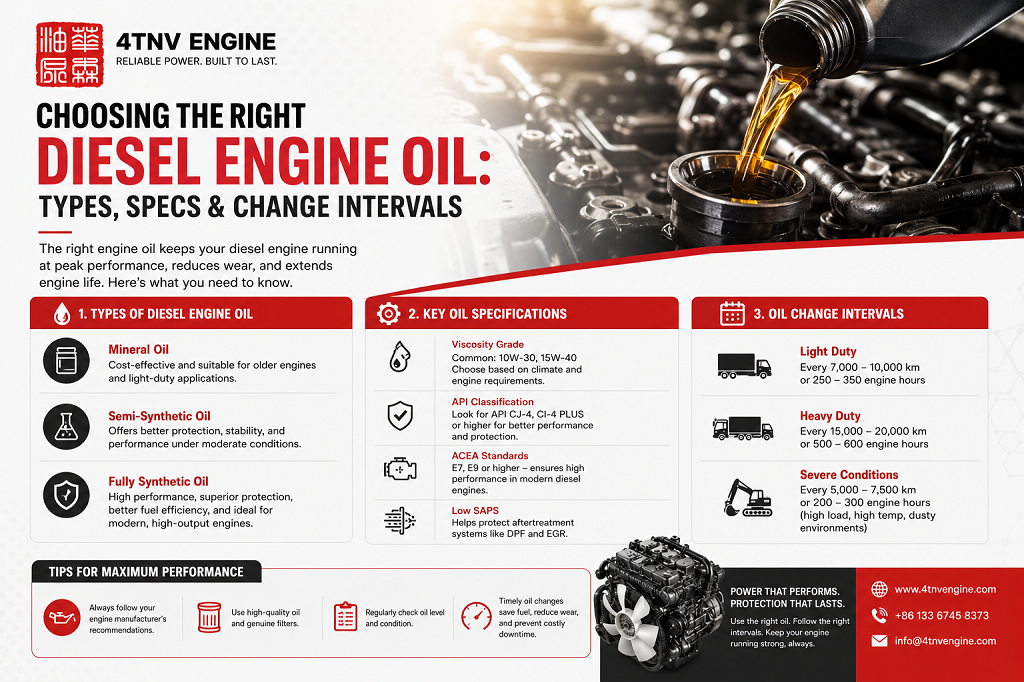
Conventional oil is derived from crude oil. It is the most affordable option and performs well in older diesel engines with looser tolerances. However, it degrades more quickly at high temperatures and requires more frequent oil changes.
Synthetic Oil
Synthetic oil is engineered at the molecular level for uniform viscosity and superior heat resistance. It provides better cold-start performance, high-temperature stability, and longer oil change intervals. Full synthetic is the preferred choice for modern, tight-tolerance diesel engines, particularly those equipped with turbochargers.
Semi-Synthetic (Blended) Oil
Semi-synthetic oil is a blend of conventional and synthetic base stocks, offering better protection than pure mineral oil at a lower cost than full synthetic. It is a practical choice for mixed fleets or transitional situations where the cost of full synthetic oil cannot be justified across all engines.
Decoding the Specs: What Those Numbers and Letters Actually Mean
Oil specifications are not arbitrary. They define exactly what a product is designed to do, and using an oil that does not meet your engine’s rating requirements can void warranties and cause accelerated wear.
The two key rating systems for diesel engine oils are:
API (American Petroleum Institute) Ratings
Look for “CK-4” or “FA-4” on the label. CK-4 is the current standard for most heavy-duty diesel engines, offering improved oxidation stability and shear resistance. FA-4 is designed for newer engines that operate at lower viscosities to improve fuel economy.
ACEA (European Automobile Manufacturers’ Association) Ratings
These ratings are common on European equipment. E6, E7, and E9 are the relevant classifications for heavy-duty diesel engines. E9 is recommended for modern low-emission engines. Engine OEMs specify viscosity grades such as 15W-40 and 5W-30. Always select the viscosity grade appropriate for your operating climate, as oils formulated for hot conditions may not perform adequately during cold-weather startups.
Engine Oil Change Intervals
The old “every 3,000 miles” rule is outdated and wasteful. Today’s diesel engines — particularly those using high-quality synthetic oil — can safely operate at extended drain intervals. However, the appropriate interval varies depending on several factors:
Factors That Affect Change Intervals
- Duty cycle: Severe or heavy-duty cycles, high operating temperatures, and high dust loads degrade oil more rapidly than lighter-duty applications.
- Oil quality: Full synthetic oil may allow drain intervals of 10,000–15,000 miles under ideal conditions, while mineral oil typically requires changes every 5,000–7,500 miles.
- Engine condition: Older engines with greater blow-by will accelerate oil degradation, shortening the drain interval regardless of oil type.
- OEM recommendations: Always use the manufacturer’s recommended drain interval as a baseline, then adjust based on operating conditions and oil analysis results.
Conclusion
Every diesel engine has a tolerance threshold. Push beyond it with the wrong oil specification, incorrect viscosity, or an overdue oil change — and the engine will not warn you. It will simply fail. The best strategy is to select oil that matches your engine’s operational requirements, follow a maintenance schedule grounded in real data, and treat lubrication as a primary concern — not an afterthought.
At 4tnvengine, we provide reliable solutions and support to keep your diesel engine running at its best. Our range of products is available for you to evaluate and use to meet your business needs. Your engine’s longevity depends on the choices you make today.
FAQs
What happens if I use the wrong oil in my diesel engine?
The wrong oil will fail to adequately protect against soot buildup, acid accumulation, and heat stress, resulting in accelerated engine wear and potential long-term damage.
Can I use 5W-30 instead of 15W-40 in my diesel engine?
It depends on your OEM specifications and operating temperature range. Using a low-viscosity oil under high heat and heavy load conditions can compromise oil film strength and increase metal-to-metal contact, leading to premature wear.
How will I know when to change my diesel engine oil?
The most reliable method is oil analysis testing, which measures oxidation levels, metal particle content, and remaining additive life — giving you an accurate picture of your oil’s condition rather than relying on mileage estimates alone.
Is it worth using synthetic oil in older diesel engines?
Synthetic oil’s superior cleaning properties can dissolve accumulated sludge in older engines. However, this is worth noting: in some cases, the removal of sludge that has been filling worn seals can cause minor leaks to become apparent. This is a sign of pre-existing wear, not a result of the synthetic oil itself.